
8th September 2026
Executive Summary
Africa’s illicit gold economy has developed into a transregional security and financial system connecting conflict-affected production, regional trading hubs and major Gulf bullion markets. Armed groups, security networks and politically connected intermediaries can extract value close to production before gold crosses borders, enters aggregation markets and acquires the documentation needed for formal international trade. The United Arab Emirates (UAE) remains central because its liquidity, refining capacity and connectivity make it one of the largest markets for African gold, while stronger Emirati regulation increasingly depends on provenance information generated much earlier in African supply chains. Sudan, the Great Lakes and West Africa show that the principal regulatory weakness sits where gold moves from production into formal commerce. Once provenance weakens, sophisticated sanctions, customs controls, and refinery due diligence must reconstruct a commercial history that the supply chain may already have obscured.
The Security Economy of Gold
Africa’s illicit gold trade has reached a scale that affects fiscal sovereignty, conflict financing and regional security. SWISSAID estimates that between 321 and 474 tonnes of artisanal and small-scale gold are produced annually in Africa without being declared, while at least 435 tonnes were smuggled from the continent in 2022, worth around USD 31 billion at the time. Almost 80 percent of African gold exports went to the UAE, Switzerland and India that year, with the UAE accounting for roughly 47 percent. Emirati gold imports reached 1,059 tonnes worth USD 59.5 billion in 2022, including around 609 tonnes from Africa valued at USD 34.5 billion. By 2024, UAE imports had risen to 1,392 tonnes, including approximately 748 tonnes from African suppliers. These flows include legitimate industrial production, formally exported artisanal gold, transit trade and metal whose source is difficult to establish, but the scale of the discrepancies between production, declared exports, and destination-market imports shows how much African gold moves through commercial systems that national regulators do not fully control.
The security implications depend on the point at which value is extracted from that trade. Informal gold, smuggled gold, conflict gold, and laundered gold refer to different stages and mechanisms. Artisanal production can remain outside formal licensing without financing an armed organisation. Gold becomes conflict-linked when an armed group, military actor, abusive security network or politically protected structure extracts revenue through control of mines, taxation, road access, protection payments, compulsory purchasing or participation in trading networks. Smuggling moves the commodity outside customs, tax or licensing rules, while laundering obscures its origin sufficiently for the metal to re-enter legitimate commerce. A single consignment can move through several of these categories before reaching a refinery.
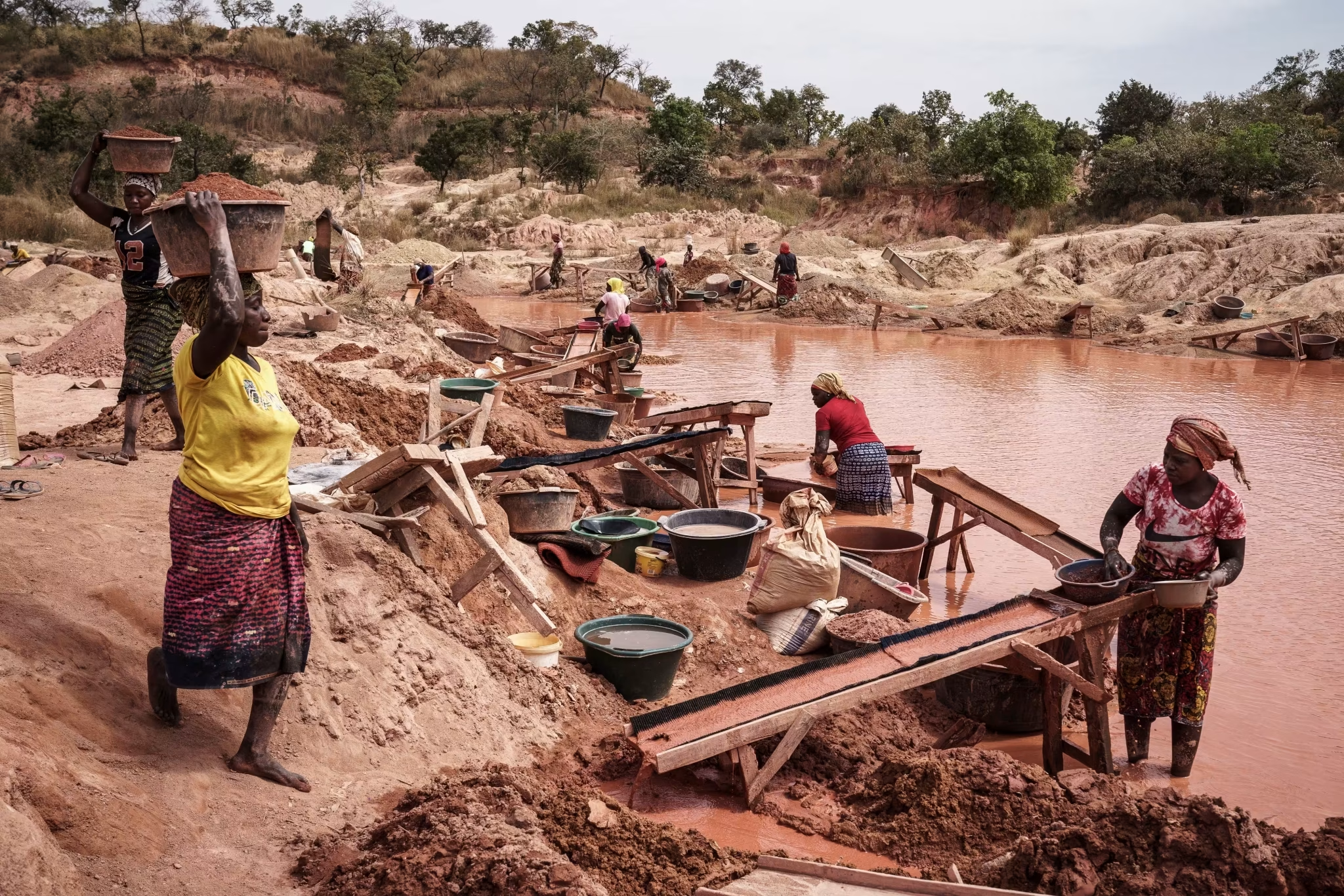
Gold is exceptionally well suited to this process because political control over a relatively small physical asset can be converted into internationally usable value. The commodity is highly valuable relative to its weight, denominated in global terms, easily transported, divisible, durable, and readily convertible into hard currency. It can bypass domestic banking systems and retains value across borders where national currencies may be unstable or inaccessible. In conflict economies, these characteristics allow armed organisations and politically connected networks to finance salaries, fuel, transport, procurement and patronage without capturing a central bank or controlling a conventional tax system. The security transaction can therefore occur near the mine or the first point of purchase, long before the gold reaches the formal institutions that subsequently regulate its export, financing, or refining.
The commercial chain then creates distance between the original beneficiary and the final buyer. A mine can be located in territory under armed control, while the next buyer operates through a local trading network; another company aggregates several consignments, the gold crosses into a neighbouring state, a licensed exporter prepares documentation, and a refinery eventually processes the metal into standardised bullion. The actors operating at the end of that chain can face a fundamentally different product from the one that existed at the beginning: commercially documented, physically refined and increasingly detached from the political conditions under which its first value was extracted. That separation between where security risk is generated and where commercial legitimacy is established defines the wider policy problem.
Sudan’s War Economy
Sudan demonstrates the consequences most clearly because gold has become embedded in competing wartime political economies. Following the outbreak of war between the Sudanese Armed Forces (SAF) and Rapid Support Forces (RSF) in April 2023, the formal economy fragmented while gold production continued across territories controlled by both sides. Sudanese production was estimated at around 70 tonnes in 2025. Official export figures vary across government data and international assessments, with some series recording approximately 14.5 tonnes and others around 20 tonnes. Wartime measurement remains difficult, but the gap between production and formal exports is large across all credible estimates. That gap represents a substantial volume of gold moving outside the export channels through which the state can monitor foreign-exchange receipts, taxation and ultimate destination.
The current war intensified a political economy that pre-dated April 2023. Gold had already become increasingly important after South Sudan’s independence in 2011 removed much of Sudan’s oil production and foreign-exchange base. Military and security institutions accumulated commercial interests in mining, while the RSF developed particularly strong influence over production and trading networks in Darfur. By the time the current conflict began, both the SAF and RSF were connected to economic structures capable of operating beyond conventional state finance. United Nations investigations subsequently documented gold in RSF-linked commercial networks, including a 50-kilogram consignment delivered to an RSF-associated trader in Dubai in May 2023. In July 2026, the United Kingdom (UK) sanctioned companies and individuals connected to gold trading, mining, finance and procurement associated with both SAF- and RSF-linked economic networks, reflecting the extent to which the commodity now sustains competing centres of military power.
The strategic value of gold lies in its ability to convert territorial influence into external purchasing power. RSF-linked networks draw on production and trading activity in Darfur and parts of Kordofan, where access to mining areas, traders and cross-border routes can generate revenue without the organisation controlling Sudan’s formal fiscal institutions. SAF-aligned authorities retain greater access to production areas in northern and eastern Sudan and to state-linked mining companies, but they face the same pressure to convert domestic production into foreign exchange. The resulting system allows military actors to maintain commercial relationships that extend beyond the territory they administer and reduces their dependence on a unified national economy. Gold, therefore, reinforces the economic durability of fragmentation by providing competing armed structures with a revenue source that can survive institutional collapse at the centre.
The routes carrying that gold have become part of the war economy itself. RSF-linked production can move west and south through Chad, Libya, South Sudan and the Central African Republic (CAR), while SAF-linked flows have increasingly moved north through Egypt. These corridors also support the movement of fuel, vehicles, food, equipment, hard currency and, in some cases, weapons. Gold finances the outward leg of the network while goods and liquidity travel inward. The commercial relationship therefore links local coercive control to a wider regional market, allowing conflict actors to remain connected to external finance even when formal diplomatic and banking channels narrow.
Sudan also demonstrates why sanctions against individual actors can disrupt networks without necessarily dismantling the underlying corridor. A sanctioned company can lose access to formal finance, but another intermediary can acquire the same gold; a direct route can become politically difficult, but traders can move through another neighbouring state; a specific buyer can become high-risk, while the commodity retains the same global price and portability. The resilience of the system rests on its division of labour. Armed organisations need control over production, taxation, purchasing or transport at the beginning of the chain. They can leave aggregation, documentary formalisation, refining and final sale to commercial actors further downstream.
Transit and Provenance
Transit states occupy a central position because they can transform gold’s regulatory visibility without altering the underlying commodity. Their role combines geography with access to licensed traders, foreign currency, airports, customs documentation and international buyers. When illicitly moved gold reaches a neighbouring state, it can be aggregated with other supply, sold to locally registered companies, exported under new documentation or processed before re-export. The resulting shipment may carry a legitimate commercial paper trail from the transit country even when its mine-level origin lies elsewhere. Provenance therefore weakens progressively as additional commercial and jurisdictional layers are inserted between production and final market.
South Sudan illustrates the process in direct terms. Reporting from Juba in 2026 described gold originating in Darfur and South Kordofan arriving through regional trading networks, being purchased in United States dollars, and subsequently entering South Sudanese export channels before moving to the UAE. The decisive regulatory change occurs when undocumented or illicitly moved Sudanese metal enters a commercial system capable of generating legitimate documentation. The gold does not need to remain clandestine for the full journey to Dubai. It needs to cross the point at which the next buyer can rely on papers produced after the original border movement has already occurred.
Egypt represents a larger and politically more consequential version of the same mechanism. Research has estimated that more than 60 tonnes of Sudanese gold may have entered Egypt between April 2023 and the end of 2024, much of it outside formal Sudanese export records. Egypt’s own annual mine production was around 15.8–16 tonnes, while its gold exports reached approximately 29.8 tonnes in 2023 and exceeded 41 tonnes during the first ten months of 2024. Around 25.9 tonnes reportedly went to the UAE during that 2024 period. These figures include legitimate imports, re-exports, processing and domestic trading activity, so the gap cannot be treated as a direct measure of Sudanese smuggling. It does, however, show that Egypt possesses the commercial capacity to absorb and re-export volumes substantially larger than its own mine production.
The Sudan–Egypt–UAE relationship also demonstrates how geopolitical tension can alter trade routes while preserving the underlying market. SAF-aligned Sudanese authorities have accused the UAE of supporting the RSF, allegations the UAE rejects, and direct political relations deteriorated sharply during the war. Sudanese gold continued to seek access to Emirati liquidity because Dubai remained commercially attractive to exporters and traders. Egypt provides an alternative route for gold originating in SAF-controlled areas to enter a broader regional trading system and ultimately reach the same international market. A fall in direct Sudan–UAE trade can therefore reflect rerouting as much as genuine disruption in commodity flows.
Chad, Libya, and the CAR perform similar functions in western Sudan, although the scale and degree of state involvement vary and available estimates remain imprecise. Their strategic value comes from their position between conflict-affected production and international transport networks. A trader moving gold out of Darfur may need local protection, aggregation, foreign currency and access to an airport before the metal reaches a Gulf buyer. Each step can introduce a new company or jurisdiction and progressively weaken downstream regulators’ ability to establish where the gold was mined, who controlled the production area, and which actors received value at the first sale.
The term “origin laundering” therefore describes a set of mechanisms that can include false declarations, aggregation, documentary reclassification, re-export and refining. Gold does not automatically acquire a legally new country of origin simply by crossing a border, and trade discrepancies alone cannot prove criminality. The more consequential problem is informational. Customs authorities and refineries may accurately identify the immediate exporter while having limited visibility into the earlier transactions that determined the commodity’s security exposure. The document presented at the final export point can be valid within that jurisdiction while providing an incomplete account of where the gold entered commerce.
The Great Lakes
The Great Lakes region provides a harder test of the argument because it already possesses extensive conflict-mineral regulation. The International Conference on the Great Lakes Region (ICGLR), national certification systems and Organisation for Economic Co-operation and Development (OECD) standards have created a formal architecture intended to preserve mineral provenance and prevent armed actors from benefiting from trade. Gold has remained particularly difficult to trace because artisanal production is geographically dispersed, trading networks operate through layers of intermediaries, and the metal can be melted or mixed far more easily than bulk commodities.
The June 2026 United States (US) sanctions on Rwanda-based Gasabo Gold Refinery provide one of the clearest contemporary examples. US authorities alleged that gold originating in areas of South Kivu controlled by the March 23 Movement (M23) and the Rwanda Defence Force (RDF) was transported into Rwanda under military supervision and delivered to the refinery. At least 60 kilograms reportedly moved through that network during early 2026, with refining beginning shortly after delivery. The case captures the point at which a commodity carrying identifiable conflict exposure can cross a national border and immediately enter the physical and regulatory infrastructure of the formal gold market. Once refining begins, reconstructing the original mine-level provenance becomes increasingly dependent on documentary evidence and intelligence about the upstream network.
Uganda provides a larger example of the aggregation problem. Reported Ugandan gold exports reached approximately 62 tonnes in 2025, valued at around USD 6.4 billion, despite domestic mine production being far below that volume. In 2024, the UAE imported approximately 31 tonnes from Uganda and 19 tonnes from Rwanda. Both states operate legitimate trading and refining businesses, and export volumes above domestic production can reflect imported material and re-export. Persistent gaps between plausible domestic production and outbound trade nevertheless identify jurisdictions where provenance depends heavily on the quality of records accompanying imported gold. The risk increases where established smuggling routes connect those markets to conflict-affected production in eastern DRC.
The Primera Gold DRC experiment is equally important because it demonstrates the limits of formalisation from inside a producing country. Established in 2022 as a joint venture intended to formalise artisanal purchasing and reduce smuggling from South Kivu, Primera increased official exports rapidly and shipped more than five tonnes worth over USD 300 million in 2023. Subsequent investigations raised questions about whether the purchasing system could reliably distinguish all gold entering its supply chain from production associated with armed-group presence, child labour and other high-risk conditions. The initiative increased the volume of gold entering formal export channels, while mine-level provenance remained difficult to verify across dispersed artisanal sites and intermediary networks.
The Great Lakes experience therefore separates three concepts that are often treated as interchangeable: formal trade, legal documentation and reliable provenance. A licensed exporter can purchase gold whose earlier history is uncertain. A refinery can process gold supplied by a legitimate company and still depend on records created by actors several steps removed from the mine. A bank can process a payment for a transaction that complies with formal company and financial rules, even when the original extraction and initial purchase occurred under conditions the downstream institution cannot independently reconstruct. The supply chain can become more administratively formal as it moves towards the international market while becoming less transparent about the conditions under which the commodity first entered commerce.
Intermediaries occupy the centre of this problem. They aggregate production from geographically dispersed miners, provide pre-financing, transport gold across difficult terrain and connect local sellers to regional exporters. Their commercial role gives them disproportionate control over information about origin. The artisanal miner may know little about the eventual buyer; the refinery may know little about the individual mine; the intermediary sits between both and can determine how much of that history survives. Traceability therefore depends heavily on actors whose economic advantage can derive from flexibility, aggregation and the ability to move gold towards whichever jurisdiction offers the strongest price and easiest access to international markets.
West African Arbitrage
West African gold flows show that illicit movement is shaped as much by regulatory differences as by weak border enforcement. Traders respond to taxes, licensing costs, purchasing prices, foreign-exchange rules and export procedures across neighbouring jurisdictions. Gold therefore tends to move towards the state offering the most commercially attractive route into the international market, creating regional corridors that can persist even when an individual government tightens its own controls.
Historically, Mali became an important regional hub because favourable export arrangements made Bamako attractive to traders handling gold from neighbouring countries. Research on the Mali–Dubai supply chain found that gold produced in Senegal and elsewhere could enter Malian channels before formal export. Some historical assessments estimated that a very large share of artisanal gold entering parts of Mali’s trading system originated from outside its borders. The exact proportions vary considerably and should not be treated as fixed current estimates, but the underlying incentive is clear: when neighbouring countries impose different taxes and documentation requirements on the same high-value, easily transported commodity, traders can capture the difference by shifting the declared point of export.
Togo provides a particularly stark contemporary indicator. UAE trade data recorded approximately 52 tonnes of gold imports from Togo in 2024, despite Togo producing little gold domestically. The figure does not establish that those exports were illicit. Togo can legitimately serve as an aggregation and re-export market. Its scale nevertheless demonstrates how quickly the commercial identity of African gold can shift from the producing state to a regional trading hub. Once the gold is exported through a jurisdiction with limited domestic production, downstream buyers need reliable information about where the underlying metal originated and through which trading networks it passed.
Ghana has approached the same problem from the producing side. Estimates based on discrepancies between Ghanaian export records and destination-country import data identified a gap of around 229 tonnes worth roughly USD 11.4 billion across several years. Mirror-trade statistics contain methodological problems, including timing, valuation, classification and re-export effects, and cannot be converted directly into proven smuggling volumes. Persistent discrepancies still provide a strong indicator that official domestic records capture only part of the commercial movement and that gold can leave the country through neighbouring jurisdictions before appearing elsewhere as a legitimate import.
The establishment of the Ghana Gold Board (GoldBod) therefore represents an important attempt to move state control closer to the first commercial transaction. During 2025, approximately 103.8 tonnes of small-scale gold were exported through GoldBod, with more than 72 percent going to Dubai and around one-quarter to India. The model remains new, and concentrated state purchasing carries governance risks of its own, but its institutional logic addresses a vulnerability repeatedly visible elsewhere: the state is trying to capture gold when miners and aggregators first convert production into money, before a network of regional intermediaries can move it towards another export jurisdiction.
The commercial contest at that first purchase is central to formalisation. Informal buyers can offer immediate cash, foreign currency, transport, equipment advances and flexible documentation. Formal systems frequently impose licensing requirements, compliance costs, waiting periods, and tax deductions. When a miner can receive a better or faster price from an informal trader, weak enforcement is only part of the explanation for why gold remains outside official channels. The formal market is competing with a financing and purchasing network that may already have deep relationships with miners and local brokers. Any regulatory architecture that concentrates predominantly on customs and final export therefore intervenes after the commercial relationship supporting opacity has already been established.
The UAE Gold Market
The UAE occupies a central position in African gold trade because Dubai combines liquidity, refining capacity, transport connectivity and access to global buyers at a scale few competing markets can match. The same commercial infrastructure serves formal African mining companies, licensed artisanal exporters, regional trading houses and supply chains whose original provenance is less certain. This overlap explains why the UAE’s role should be assessed through market structure and regulatory leverage as much as through individual allegations concerning illicit shipments.
African gold has become economically important to the UAE market. In 2022, approximately 609 tonnes of the UAE’s 1,059 tonnes of gold imports originated in Africa, worth around USD 34.5 billion. By 2024, African shipments had increased to roughly 748 tonnes. Ghana alone sent more than 72 percent of the small-scale gold exported through GoldBod in 2025 to Dubai. The depth of demand gives African producers and traders access to competitive buyers, rapid settlement, refining services and onward connections into India and wider Asian bullion markets. Those same characteristics lower the commercial cost of moving opaque supply because a trader who can get gold into the Dubai market gains access to one of the world’s deepest gold trading ecosystems.
The relationship also extends upstream through finance. During disruptions related to the Middle East conflict in 2026, traders in North Kivu reported difficulty purchasing gold as access to Dubai-linked liquidity tightened. That evidence indicates that the flow is circular: African gold moves towards the Gulf, while capital can move through trading networks towards African miners and aggregators. Gulf demand therefore helps shape purchasing conditions well before a consignment reaches the UAE. Intermediaries able to obtain finance from downstream buyers can offer immediate cash to miners, compete with formal domestic purchasing schemes and consolidate supply across several producing areas.
The UAE’s regulatory architecture has strengthened materially. Gold dealers are classified as a high-risk anti-money-laundering sector and refineries as the highest-risk subsector. Since January 2023, UAE refineries have been required to apply responsible-sourcing rules modelled on the OECD five-step framework. The requirements extend to supplier relationships, transportation, processing, cross-border trading, risk assessment, continuing monitoring and independent third-party auditing, including businesses operating through free zones. These rules reach further upstream than older portrayals of Dubai’s gold market suggest.
Their effectiveness still depends heavily on the integrity of information created before the gold enters UAE jurisdiction. A refinery purchasing from a licensed Ugandan exporter can conduct extensive checks on that exporter and still struggle to determine whether part of the consignment originated in Ituri and entered Uganda through unofficial Congolese channels. A UAE buyer receiving Egyptian gold can verify Egyptian documentation while still relying on Egyptian and Sudanese records to determine whether the underlying metal includes production that was originally sourced from Sudan outside formal controls. The downstream institution therefore confronts an evidential problem created earlier in the chain.
Dubai’s scale consequently creates both exposure and leverage. The UAE faces reputational, sanctions and anti-money-laundering risks when opaque African gold reaches its market, while the commercial importance of Dubai gives Emirati regulators and buyers considerable influence over what African exporters must demonstrate to retain access. Stronger source requirements can affect behaviour across producing and transit states because exclusion from Dubai carries a real commercial cost. That influence still depends on whether the information supplied from upstream jurisdictions is sufficiently reliable to distinguish locally produced gold, legitimate transit trade and metal whose provenance has already been obscured.
Sanctions and Due Diligence
The regulatory response in 2026 shows that governments increasingly understand the transnational nature of the problem. On 13 July 2026, the European Union (EU) strengthened its Sudan sanctions framework by prohibiting the purchase, import or transfer of Sudanese-origin gold, including gold that had first been exported from Sudan to a third country after 15 July. The provision is analytically important because it preserves Sudanese origin in law even after the commodity crosses another border. Transit through Egypt, South Sudan, or another jurisdiction, therefore, does not automatically remove the gold from the scope of the restriction.
The difficulty lies in proving the source once the commodity has passed through several commercial stages. Sudanese gold entering Egypt can be aggregated with other metals, processed or sold through local traders before onward export. The legal rule can continue to classify the original Sudanese material as sanctioned, but enforcement depends on customs authorities, traders, refiners and banks preserving enough reliable evidence to identify it later. The EU measure therefore captures the problem conceptually while exposing the weakness of the information infrastructure required to enforce it.
The UK’s July 2026 sanctions operate through a different mechanism by targeting named mining companies, financiers and procurement networks connected to the SAF and RSF. Such measures constrain access to formal banking, increase legal risk for counterparties and can disrupt established relationships. Their structural limitation arises from the adaptability of gold networks. Commercial actors can be replaced, new companies can emerge, routes can shift, and a fungible commodity can be sold through different intermediaries. The sanctions burden, therefore, falls most effectively when designations are reinforced by intelligence capable of tracing the commercial corridor beyond a single company.
Physical transformation compounds that problem. Gold can be melted, mixed, recast and refined with metal from several sources. After that process, documentary records become the principal mechanism for preserving provenance because the final bullion product carries little visible evidence of which mine produced each component. The same difficulty applies to recycled gold. A classification designed for jewellery, scrap, and previously refined bullion can weaken the connection between a downstream transaction and the original mine if the chain of custody is not intact through each transformation.
The regulatory system is therefore confronting a basic tension between the economics of gold and the requirements of conflict-finance control. Bullion markets depend on fungibility: refined gold is valuable precisely because one standardised unit can be exchanged for another. Responsible sourcing depends on historical differentiation: the market needs to know that two physically identical units may carry completely different security and political histories. Once the chain of custody fails, downstream compliance must attempt to reconstruct distinctions that the commercial process is designed to erase physically.
The Regulatory Gap
Existing governance is fragmented across institutions whose responsibilities correspond to different stages of the supply chain. Mining authorities oversee production and licensing; local trading regulators register buyers; customs authorities record imports and exports; central banks monitor foreign-exchange receipts; refineries conduct supply-chain due diligence; banks assess financial transactions; sanctions authorities designate companies and individuals; regional certification systems establish origin requirements. Each institution can regulate its own part of the chain effectively while remaining dependent on information generated by actors operating elsewhere.
The most vulnerable point lies between production and formal export, where the gold first becomes money and begins to move through commercial networks. An armed organisation or a politically connected actor can extract value from the area around the mine. A local intermediary can finance production or purchase the gold in cash. A regional trader can aggregate several consignments and move them across a border. A licensed company in the transit state can then prepare the initial documentation that downstream regulators can easily verify. The security exposure entered the chain before the strongest compliance systems became involved.
This is why the policy architecture currently targets the wrong point in the chain. Its most enforceable controls surround formal exporters, refineries, banks and designated entities because those actors possess licences, accounts, addresses and documentary records. The hardest provenance problem lies earlier, in artisanal production, informal purchasing, cross-border aggregation, and politically protected trading networks. Regulation becomes more sophisticated precisely as the underlying information about origin becomes more dependent on records created by preceding actors.
Digital traceability does not remove that problem on its own. A digital certificate can make records harder to alter after entry and improve information exchange between authorities, but it cannot establish that the first recorded information was accurate. If Congolese gold is falsely documented after entering Uganda, the electronic system can perfectly preserve the wrong origin. If undocumented artisanal production is mixed into a licensed trader’s stock before registration, subsequent tracking begins after provenance is compromised. Traceability is therefore an institutional and political problem before it becomes a technological one.
The evidence from Ghana suggests why intervention at the first purchase may become increasingly important. GoldBod seeks to create a formal state-controlled buyer capable of competing for artisanal supply before regional intermediaries establish ownership and financing relationships. The Great Lakes experience illustrates the opposite risk: formal export systems can expand even as upstream verification remains incomplete. Sudan demonstrates the most extreme constraint because governments cannot effectively regulate first purchase in mining areas outside their territorial control. In those environments, the provenance problem becomes intrinsically regional because the next meaningful regulatory opportunity may sit across an international border.
The corridor therefore provides a more useful analytical unit than the individual state. Sudanese gold moving from Darfur through Chad, Libya, South Sudan, or the CAR into Gulf markets is subject to several jurisdictions before final sale. Gold from SAF-controlled areas can move through Egypt towards the UAE. Congolese production can pass through Rwanda or Uganda before being refined and exported. West African gold can shift among Ghana, Togo, Burkina Faso and Mali depending on price, taxation and documentation requirements. In each case, national reform can raise the cost of one route while increasing the attractiveness of another.
Persistent provenance is the missing connective tissue across those jurisdictions. Sudanese production should retain its Sudanese mine and transaction history after entering Egypt or South Sudan. Congolese gold should retain mine-level information after entering Uganda or Rwanda. Refining, aggregation, and recycled classification should preserve the metal’s security history even when its physical form changes. Achieving that continuity requires information to survive precisely where existing incentives often favour opacity: at the first purchase, across borders and through aggregation.
The challenge is ultimately as political as it is administrative. Some states genuinely lack the resources to monitor artisanal production or remote borders. In other settings, traders, officials, security personnel and politically connected companies derive income from the existing arrangements. Transit trade can generate foreign exchange, taxes, brokerage revenue and commercial opportunities. Stronger provenance therefore threatens established interests as well as illicit actors. Describing the problem simply as weak regulatory capacity misses the incentives that can make opacity economically valuable to institutions and elites embedded in the trade.