
24th September 2026
Executive Summary
Iran, the United Arab Emirates (UAE), South Africa, Egypt and Ethiopia arrived at the 12–13 September BRICS Summit with different security relationships, economic priorities and external partnerships. Despite these differences, they reached agreement on trade access, payment diversification, development finance, technology and reform of international institutions. The outcome points to a looser but more practical form of cooperation, allowing members to preserve their national strategies while selectively drawing on common institutions. For African and Middle Eastern states, BRICS is increasingly valuable as a means of widening diplomatic, financial and technological options. The next test will be whether this flexible model can deliver tangible gains in investment, market access and institutional influence as China assumes the presidency in 2027.
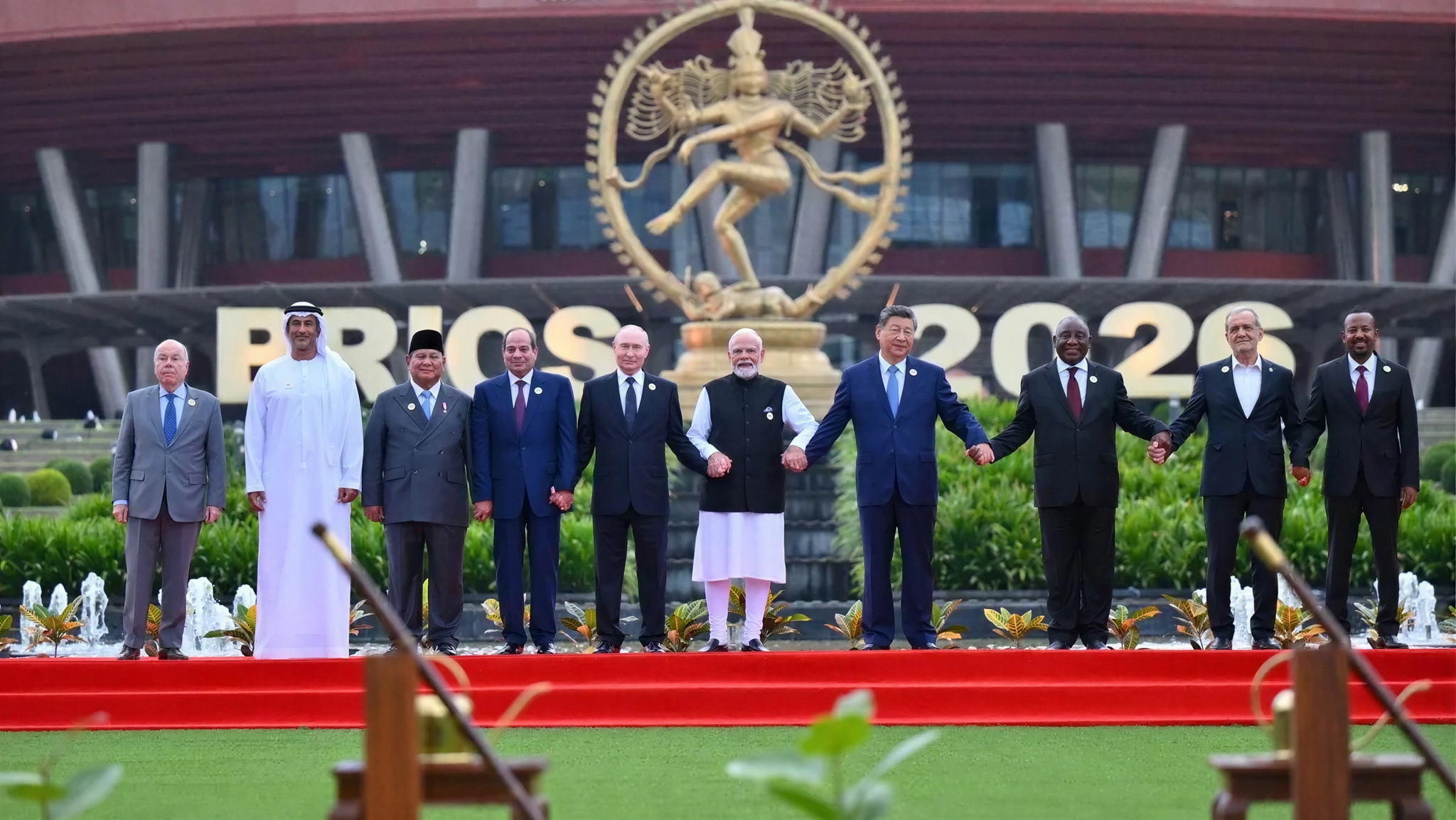
The New Delhi Summit produced a 140-paragraph declaration after earlier ministerial negotiations had struggled to find common language on the Middle East. The eventual agreement provided the clearest indication that the expanded grouping is learning to manage greater internal diversity. Iran and the UAE endorsed the same declaration despite holding sharply different positions on regional security. Iranian President Masoud Pezeshkian also met UAE Crown Prince Sheikh Khaled bin Mohamed bin Zayed Al Nahyan during the summit. The final text called for restraint, the protection of civilians and the continuation of trade and energy flows. It also condemned attacks on safeguarded Iranian nuclear facilities and opposed unilateral sanctions imposed outside the United Nations Security Council (UNSC) framework. BRICS maintained cohesion by focusing on areas where members’ interests converged, while containing disputes that could not be resolved collectively.
Iran and the UAE illustrate how this model operates. Iran seeks greater protection from sanctions, wider use of local currencies and payment channels that reduce its exposure to external financial pressure. The UAE approaches BRICS from a stronger financial position, using the grouping to expand trade, investment and diplomatic connectivity while maintaining extensive relations with the United States (US), European Union (EU), India, China and other Gulf states. Both countries can support payment diversification, trade facilitation and diplomatic de-escalation without adopting a common security strategy. This flexibility is central to BRICS’ utility: membership does not require governments to reorganise their wider alliances around the grouping.
The payments agenda follows the same logic. BRICS leaders supported greater use of national currencies and continued work on interoperability between domestic payment and messaging systems. India, however, resisted placing the grouping behind a single China-linked payments architecture. The compromise preserves national control while creating additional settlement options. Iran views these mechanisms primarily as a source of resilience against sanctions. Egypt and Ethiopia see opportunities to lower transaction costs and widen access to finance, while the UAE sees scope for deeper commercial connectivity. The New Development Bank (NDB) plays a similar role. Its approved financing remains considerably smaller than the combined resources of the International Monetary Fund (IMF), World Bank and other multilateral lenders. Nevertheless, local-currency lending and additional infrastructure finance can give members more room to negotiate while continuing to work with those institutions.
The African members also used the summit to advance distinct national objectives. South Africa focused on critical-mineral beneficiation, artificial-intelligence governance, local-currency finance and reform of global institutions. Egypt prioritised infrastructure, development finance, technology localisation and supply-chain resilience. Its trade with BRICS economies reached approximately USD 36.7 billion during the first half of 2026. Around USD 30.2 billion of this consisted of imports, compared with only USD 6.6 billion in exports. This imbalance gives Egypt a clear incentive to turn its BRICS relationships into greater investment, domestic production and export capacity. Ethiopia pursued institutional access more directly. It secured BRICS support for its accession to the World Trade Organisation (WTO), backing for an African seat on the International Civil Aviation Organisation Council and support for an expanded NDB presence in Africa.
These different priorities highlight the limits of treating Africa’s presence in BRICS as a single position. South Africa, Egypt and Ethiopia share broad interests in development finance, industrialisation and reform of international institutions, but they do not coordinate through a permanent African mechanism within the grouping. The United Nations Security Council issue demonstrates the consequences. The summit recognised the African Union’s Ezulwini Consensus and Sirte Declaration. China and Russia, however, again gave specific support to Brazil and India for larger roles in the Council without extending the same individual endorsement to South Africa. African representation within BRICS has grown, but influence still depends on governments forming issue-specific coalitions around shared interests.
This distinction is becoming more important as trade and technology systems fragment. South Africa wants to retain more value from critical minerals. Ethiopia seeks productive investment and technology, while Egypt wants financing, industrial capacity and stronger export performance. Iran is pursuing greater economic resilience, and the UAE is seeking wider commercial reach. These agendas converge around market access, payments, infrastructure, technology and institutional reform, even when the governments concerned differ on regional security or their relationships with major powers. BRICS therefore provides members with additional instruments without demanding a shared geopolitical posture.
This also helps explain why BRICS continues to work through established international institutions rather than attempting to replace them. The New Delhi Declaration called for emerging economies to receive greater voting power within the IMF, for reform of World Bank shareholding and for stronger developing-country representation in global governance. The NDB and local-currency mechanisms provide additional leverage around that system. For African members, this creates practical opportunities to compare financing sources, build coalitions within larger institutions and negotiate with a wider range of partners. Ethiopia’s use of BRICS support for WTO accession is a clear example. BRICS cannot grant membership, but its collective backing can strengthen Ethiopia’s diplomatic position within the institution that can.
India’s 2026 presidency reinforced this decentralised approach by emphasising interoperability, national control and implementation of existing commitments. China’s 2027 presidency is likely to take the model further. China has greater financial and technological capacity than any other BRICS member and has already promoted deeper cooperation in artificial intelligence, payments and development finance. African and Middle Eastern members are therefore likely to support initiatives that expand access to capital, technology and markets, provided they retain national control over the systems through which those benefits are delivered.
The next stage of BRICS is therefore likely to centre on selective integration. Cooperation on payments, development finance, technology, trade facilitation and coalition-building within larger institutions is likely to deepen because these areas offer practical benefits without requiring members to align their wider foreign policies. China’s 2027 presidency will give this process greater scale, but the expanded membership is unlikely to accept a tightly integrated structure dominated by a single state. BRICS is instead moving towards a more durable model in which strategic diversity is preserved and used to strengthen members’ bargaining power. For African and Middle Eastern states, the greatest gains will come where governments can use the grouping to secure productive investment, technology, market access and institutional influence while retaining the freedom to work across competing external relationships.