
31st August 2026
Executive Summary
Niger’s failed 29 August mutiny shows that the security crisis in the central Sahel is beginning to affect cohesion within the armed forces. The government survived because the Presidential Guard remained loyal and Russia’s Africa Corps intervened directly, while some Nigerien formations reportedly hesitated to suppress the mutineers. The episode points to a wider problem for Niger, Mali and Burkina Faso: repeated losses to insurgent groups are increasing pressure on military command, troop rotations and internal loyalty. The likely response will be deeper coup-proofing, stronger protection of political leadership and tighter monitoring of officers, shifting more attention towards government survival even as frontline forces remain under sustained operational pressure.
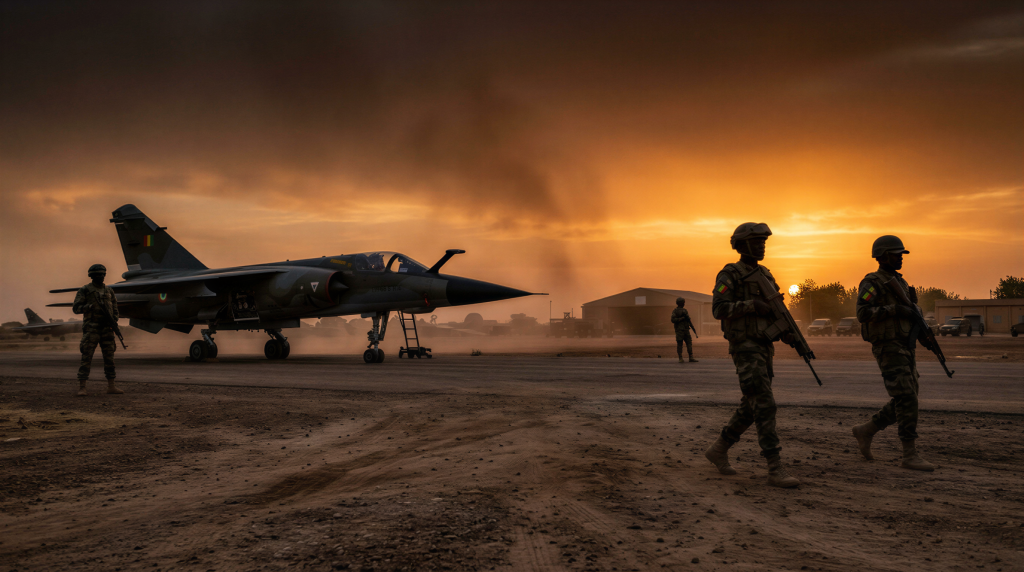
Mutinous Nigerien soldiers seized Air Base 101 at Diori Hamani International Airport on 29 August after moving against several sensitive military and government sites, including areas around the presidential compound and state broadcasting facilities. The base has become one of the most concentrated nodes in Niger’s security architecture, hosting national air assets, Russian Africa Corps personnel and elements associated with the AES joint force. The mutineers held the facility for several hours before forces loyal to General Abdourahamane Tiani retook it with the Presidential Guard and direct Russian support. At least one Nigerien battalion reportedly refused orders to storm the base, while other officers initially avoided committing to either side. Algeria also dispatched four Su-30 fighter aircraft and supporting aviation assets after Niger requested assistance. The episode therefore exposed uncertainty within the national chain of command, even as external partners helped preserve government control.
The mutiny grew out of an armed force already under heavy operational strain. Personnel linked to Ouallam, Téra, and Dosso, including officers associated with special-forces deployments, were reported to be among the participants. These areas sit close to some of Niger’s most active insurgent fronts, where Islamic State Sahel Province (ISSP) and Jama’at Nusrat al-Islam wal-Muslimin (JNIM) have repeatedly attacked military positions, transport routes and strategic infrastructure. Nigerien forces lost 51 soldiers at Inatès on 17 June after 67 soldiers and civilians were killed at Garbougna in May, while another ISSP-linked attack killed 18 soldiers in August. Local reporting has also linked the mutiny to disputes over rotations, redeployment and unequal conditions between units, although some of the more detailed accounts remain unconfirmed.
That pressure is becoming politically sensitive because the armed forces now carry both the war and the government. Tiani’s most dependable domestic formation during the crisis was the Presidential Guard, which he commanded from 2011 until taking power in 2023. Frontline formations face a different set of incentives. They absorb casualties, repeated deployments and the demands of an insurgency that is expanding across several theatres, including Tillabéri, Dosso and areas bordering Benin and Nigeria. Senior officers meanwhile occupy positions across government and state institutions. This can create a widening gap within the military between formations whose primary role is to protect political leadership and units responsible for sustaining territorial operations. The refusal of some soldiers to fight fellow service members on 29 August shows how quickly that gap can affect command authority during an internal crisis.
Mali already displays a related pattern. General Assimi Goïta has tightened control over the security apparatus through repeated officer rotations, arrests and removals, while concentrating defence authority more closely around the presidency. The military has faced major territorial pressure during 2026, including the April offensive that returned Kidal to rebel control and continued JNIM pressure on major transport corridors. Earlier arrests over alleged coup plotting and subsequent purges indicate that senior political leaders already treat internal military cohesion as a major security concern. Niger’s mutiny will reinforce that calculation because it demonstrates how battlefield frustration can move from operational units into the political centre without first developing into a broad army-wide rebellion.
Burkina Faso has developed a different structure around Captain Ibrahim Traoré. The government relies on the regular armed forces, the Volunteers for the Defence of the Homeland, and trusted security formations operating under overlapping chains of authority, while Russian personnel remain stationed near key political and military sites. This spreads the territorial burden across a broader coercive system and reduces the extent to which a single regular army formation can dominate national force. It also creates potential friction over equipment, command, local influence and access to state support. Repeated government claims of coup plots and internal military networks show that political leaders already devote substantial attention to loyalty within the armed forces, while insurgent groups continue to control or contest large areas outside the principal urban centres.
The immediate regional lesson from Niger will therefore favour stronger internal control. Mali and Burkina Faso now have additional incentives to monitor officer networks, rotate commanders, restrict concentrations of heavy weapons, strengthen intelligence oversight and keep politically trusted units close to the leadership. Russia’s intervention strengthens those incentives because it changes the calculation facing potential mutineers. Approximately 200–300 Africa Corps personnel are believed to be present in Niger, within a wider Russian deployment of around 1,700–2,000 across the Sahel. Their involvement at Air Base 101 showed that a domestic military force may have to confront an armed force operating outside the national chain of command and directly tied to the incumbent government.
That gives Russia a role with consequences extending beyond counter-insurgency. Russian forces have struggled to reverse territorial losses against armed groups in Mali and have suffered their own battlefield setbacks, but their value to military governments can remain high if they provide reliable support around political centres, strategic bases and leadership protection. The Niger operation demonstrated this more clearly than previous training or advisory deployments because Russian personnel helped suppress Nigerien soldiers during an internal rupture. For officers in Mali or Burkina Faso contemplating a similar challenge, the expected cost has therefore increased, even as dissatisfaction within their own armed forces continues to grow.
The Alliance of Sahel States (AES) response revealed a different limitation. Mali and Burkina Faso rapidly backed Niger politically and described the mutiny as a threat to wider confederal stability, yet there is no clear evidence that either deployed forces that played a decisive role in restoring control. The visible operational support came from Russia and Algeria. This suggests that AES political solidarity currently outpaces its ability to respond collectively to an internal military crisis, even though Air Base 101 hosts elements of the joint force. The three governments now share a stronger interest in preventing the military replacement of any member leadership, because a successful coup could disrupt the confederation, alter relations with Russia, and create a precedent for dissatisfied officers elsewhere. That interest is likely to drive closer intelligence coordination around military dissent before it produces a formal doctrine for intervention against mutinous forces.
Algeria’s involvement adds another layer to Niger’s external security options. The dispatch of Su-30 aircraft showed that Algeria is prepared to act when instability in a neighbouring Sahel state threatens a sudden breakdown in political and military control, despite its complicated relations with the AES and longstanding caution over foreign military involvement in the region. Niger consequently retained access to support beyond Russia during the crisis. The combination of Russian ground and aerial assistance with Algerian airpower also shows how quickly an internal military dispute can draw in neighbouring and external security actors once the political centre appears vulnerable.
The failed Niger mutiny will strengthen incentives to keep trusted formations close to political leadership, expand intelligence monitoring of officers, rotate commanders more aggressively, restrict access to heavy weapons and rely more heavily on external partners that sit outside national chains of command. These measures can make military governments harder to remove while changing how coercive power is distributed inside the armed forces. Frontline units will continue to bear the operational burden of fighting ISSP, JNIM, and other armed groups, while politically reliable formations increasingly concentrate on protecting the centre. Across the AES, this is likely to produce governments that focus more on ‘coup-proofing’ even as battlefield pressure remains severe. The defining security problem is therefore shifting towards the simultaneous management of territorial conflict and military loyalty, with coup prevention becoming embedded in how forces are organised, commanded and deployed.