
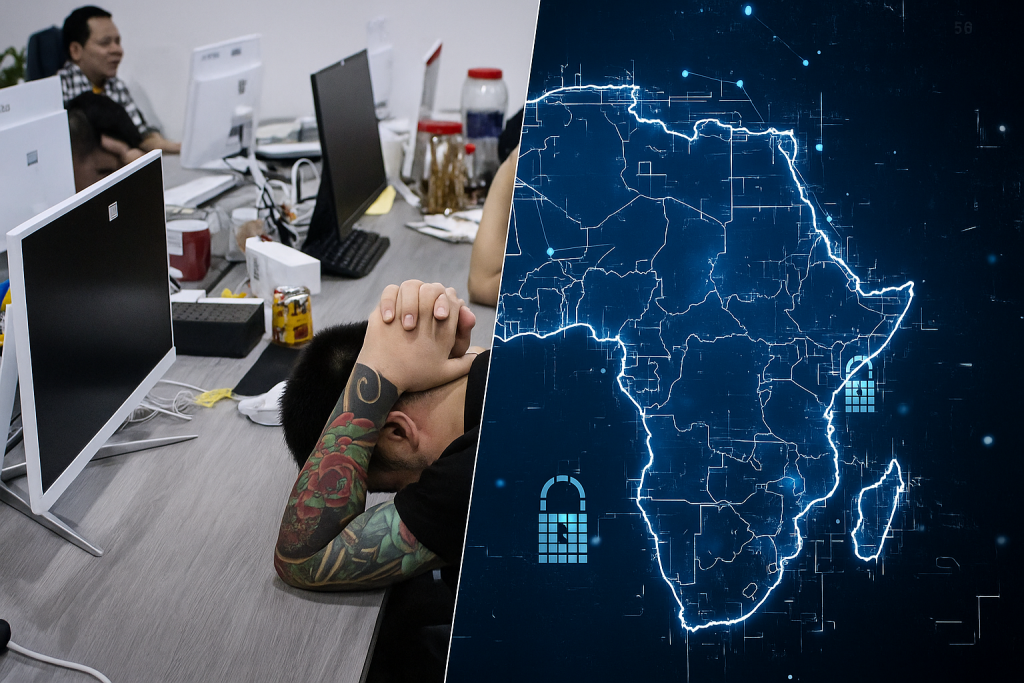
According to a report issued in April 2025 by the United Nations Office on Drugs and Crime (UNODC), transnational organised crime in Southeast Asia “is evolving faster than at any previous point in history.” This evolution is significantly propelled by the expansion of industrial-scale cyber scam compounds, predominantly operated by Chinese organised criminal groups active in countries including Myanmar, Cambodia, Laos, and the Philippines. These operations have flourished in contexts characterised by elite-level corruption, political instability, and pervasive poverty, all of which have facilitated the establishment and persistence of scam compounds.
The scale of these operations is considerable. It is estimated that scam compounds account for approximately 40 percent of the combined Gross Domestic Product (GDP) of Laos, Cambodia, and Myanmar, generating billions of US dollars in annual revenue.
Many of these compounds were initially casinos operated by organised criminal groups along China’s borders, where gambling is illegal but domestic demand remains high. In response to international and domestic travel restrictions introduced during the COVID-19 pandemic, many casino operators shifted to online fraud as a new revenue stream, particularly as Chinese customers were no longer able to travel internationally.
Although physically located in Southeast Asia, the reach of these compounds is global. Leveraging the widespread adoption of social media platforms and instant messaging applications, scammers can operate across borders and contact potential victims worldwide. These individuals are often tricked into transferring funds to fraudulent cryptocurrency platforms or into sharing sensitive images, which are subsequently used in sextortion schemes. Perpetrators are becoming increasingly technologically adept and are incorporating artificial intelligence (AI) tools to enhance the effectiveness of their scams.
Scammers typically adopt a range of fabricated identities, posing as romantic interests, potential business partners, or even individuals who have mistakenly sent a message to initiate contact. They then engage victims in prolonged communication in an attempt to build trust. This method is commonly referred to in Chinese as sha zhu pan (杀猪盘), or “pig butchering,” a metaphor for the process of grooming victims before exploiting them financially.
Human Trafficking and Forced Criminality Risks
The cyber scam industry rests on three primary pillars: weak governance, rapid technological development, and forced labour. A particularly cruel irony is that many individuals who carry out scams are themselves victims of trafficking, coercion, and forced labour. Those who fail to meet performance quotas or attempt to escape are often subjected to torture or held until a ransom is paid to secure their release.
In recent years, African nationals have increasingly been targeted for recruitment due to their multilingual capabilities, including proficiency in English and French. These linguistic skills make them valuable to scam operators seeking to target individuals in Europe, the US, and Canada. Moreover, high levels of poverty and job insecurity in many African countries further exacerbate vulnerability to such deceptive recruitment practices.
In March 2025, it was reported that the Thai military had rescued 260 foreign nationals from a compound in Myanmar, including 138 Ethiopians and 23 Kenyans. Additional reports have documented the trafficking of Nigerians, Cameroonians, South Africans, and other African nationals to Southeast Asia for the purpose of forced cyber scam work.
These individuals are often recruited under false pretences, being promised legitimate office jobs in sectors such as data entry or language instruction. Upon arrival, they are transported to remote compounds where their passports are confiscated, and they are forced to participate in fraudulent operations. One Ethiopian victim, interviewed by international media following his rescue, reported being promised a job in Laos offering USD 500 per month, significantly higher than Ethiopia’s median monthly wage of USD 24. His family raised USD 1,600 to fund his relocation to Laos, only to later pay an additional USD 5,000 to secure his release from captivity.
There is also growing concern about the recruitment of victims into the very trafficking operations to which they were initially subjected. The Ethiopian victim referenced above stated that he had been contacted by an “old friend” regarding the job offer in Laos. Kenyan authorities have likewise reported multiple cases of Kenyan nationals refusing repatriation efforts and instead choosing to participate in the cartel networks responsible for trafficking other Kenyans, often in exchange for financial compensation.
According to a report by Interpol, while the majority of identified traffickers originate from Asia, approximately 11 percent are from South America or Africa.
Globalisation of Scam Compounds
While cyber scam compounds continue to be predominantly concentrated in Southeast Asia, similar operations managed by Chinese organised crime groups have increasingly been reported in other parts of the world. A June 2025 Interpol report noted that although 75 percent of identified trafficking victims were transported to Southeast Asian scam hubs, the remainder were trafficked to locations in Central and South Africa, Eastern Europe, and West and Southern Africa. This demonstrates the growing global diffusion of this criminal model.
Many of the same structural conditions that facilitated the growth of scam compounds in Southeast Asia, such as elite corruption, political instability, weak enforcement mechanisms, and socioeconomic deprivation, are similarly present in other regions, making them attractive environments for the expansion of these operations. Heightened international law enforcement attention and increased media coverage of Southeast Asian compounds have likely contributed to this outward spread, as criminal operators seek to diversify and decentralise their activities.
In Africa, investigative reporting has identified Nigeria, Angola, and Zambia as emerging hotspots for scam compound activity. In 2024, Namibian authorities, working in collaboration with Interpol, conducted a series of raids across Windhoek as part of a broader crackdown on cyber fraud. According to domestic media, 88 Namibian youths were reportedly coerced into conducting scams under the control of a syndicate composed of Namibian and Chinese nationals.

Figure: Human trafficking victims by country of origin and new emerging hubs (Source: Interpol)
Key considerations
The expansion of scam compounds represents a structural shift in transnational organised crime. These compounds integrate human trafficking, cyber fraud, and financial crime into a single operational system that is highly adaptive to external pressures. Their persistence demonstrates the capacity of illicit economies to exploit governance gaps, technological advancements, and socioeconomic vulnerabilities across multiple regions simultaneously.
One central implication is the emergence of a new form of coerced labour economy. Individuals are trafficked not for physical work but for the production of financial crime in digital environments. This development disrupts established legal and policy frameworks on trafficking and cybercrime, which remain largely separate. It complicates the identification of victims, challenges existing definitions of coercion, and raises questions of accountability when trafficked persons are compelled to recruit or exploit others.
The establishment of compounds in African states highlights how quickly a criminal model can be transplanted into permissive contexts. It shows that structural factors such as weak regulatory oversight, high unemployment, entrenched corruption, and fragmented enforcement create environments in which criminal enterprises can embed themselves with relative ease. This diffusion indicates that the vulnerabilities first exploited in Southeast Asia are present in other regions and can be leveraged by criminal groups with minimal adaptation.
The role of African nationals across multiple levels of these operations has further implications for policy. Victims who later act as intermediaries complicate distinctions between exploitation and complicity. This underlines how economic deprivation and limited access to secure livelihoods intersect with coercive criminal structures, producing outcomes that challenge narrow interpretations of trafficking and victimhood in existing legal instruments.
The use of digital platforms, cryptocurrencies, and cross-border communications systems illustrates the extent to which these compounds exploit the global economy’s interconnected infrastructure. This creates enforcement asymmetries, where criminal actors operate seamlessly across jurisdictions while state authorities remain constrained by national boundaries. The relocation of scam operations following enforcement action in Southeast Asia reinforces this imbalance, showing that pressure in one geography leads to displacement rather than dismantling.
Taken together, these developments suggest that scam compounds are not an isolated phenomenon, but rather a manifestation of deeper systemic weaknesses in governance, regulation, and international coordination. Their spread illustrates the convergence of organised crime, migration dynamics, and digital economies, and signals the need for policy frameworks to recognise these interlinkages if future responses are to be effective.