
1st September 2026
Executive Summary
Established on 7 August 2026, the Makkah Joint Defence Agreement, or the Makkah Pact, moved quickly into institutional form on 31 August through a Strategic Political and Defence Committee, a permanent secretariat in Saudi Arabia, and commitments to joint technology development, defence production, and military cohesion. Its current strength lies in high-level deterrence, political coordination, and the gradual integration of military capabilities, while operational arrangements remain in their early stages. The three members also carry different threat priorities, which gives the framework strategic flexibility while complicating collective action during crises. Nonetheless, the pact marks an early move from externally organised Gulf security towards a more distributed system in which regional powers increasingly provide and structure parts of their own deterrence.
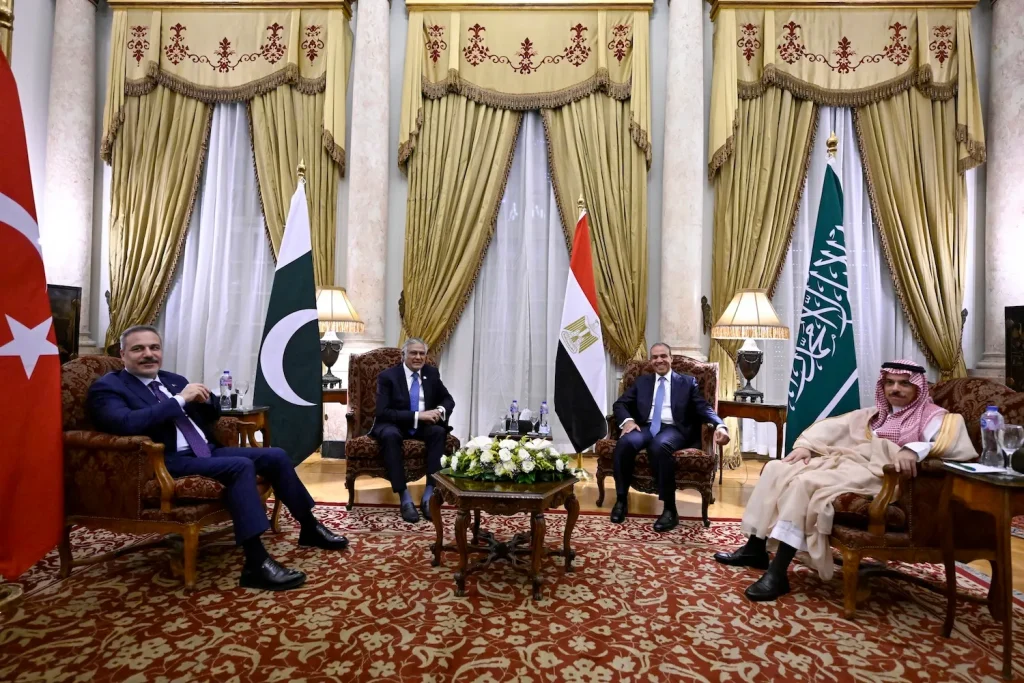
Saudi Arabia, Türkiye and Pakistan established the Makkah Joint Defence Agreement on 7 August 2026 after months in which the Iran war had exposed Gulf infrastructure, energy routes and military facilities to repeated missile and drone threats. The agreement stated that an armed attack against one member would be regarded as an attack against all three, while subsequent consultations focused on military coordination, the defence industry, and collective deterrence. On 31 August, the three governments convened their first Strategic Political and Defence Committee meeting with foreign ministers, defence ministers and chiefs of staff participating in the same structure. They agreed to establish a permanent secretariat in Saudi Arabia, appoint a Pakistani secretary-general for an initial three-year term, expand joint activities and military cohesion, and develop common defence technologies and production. The pace of institutionalisation gives the agreement a more durable political foundation than many previous regional defence initiatives.
The conditions behind the pact extend beyond the immediate military pressure created by the Iran war. Saudi Arabia has spent several years broadening its security partnerships while retaining extensive United States (US) defence ties. The central issue is control over how security is organised. The US continues to provide capabilities that regional partners cannot readily reproduce at the same scale, including strategic intelligence, advanced combat aviation, missile defence, naval projection and global logistics. Türkiye and Pakistan strengthen areas where Saudi Arabia can exercise more direct influence over procurement, production, training and replenishment. Türkiye has an expanding defence industry that covers unmanned systems, missiles, electronic warfare, naval platforms, and air defence. Pakistan brings longstanding military cooperation with Saudi Arabia, personnel, engineering capacity, lower-cost manufacturing and nuclear status. Saudi Arabia adds capital, procurement demand and an industrial policy increasingly focused on localisation.
This combination is starting to move Saudi Arabia from a predominantly purchasing role towards a position in which it can organise regional military capability around its own security requirements. The 31 August commitment to joint technology development and production is therefore central to the pact’s long-term value. Cooperation in unmanned systems, munitions, electronic warfare, air defence, missile technology, naval platforms and command-and-control could gradually give the three governments greater control over the availability of critical systems during crises. Saudi financing can accelerate production in Türkiye and Pakistan, while localisation projects can move part of that industrial base into Saudi Arabia. The resulting structure would strengthen supply resilience and reduce exposure to external export approvals, replenishment delays and technology restrictions.
The military guarantee itself remains less developed than the institutional and industrial agenda. The public text provides a broad collective-defence commitment, while the full treaty remains unpublished and there is no public indication of a standing integrated command, permanently assigned forces or an automatic mechanism for deciding when collective military action should follow an attack. The framework currently provides political deterrence backed by growing military coordination. Its operational character will develop through exercises, common planning, interoperable communications, air defence integration, and shared logistics. The Strategic Political and Defence Committee places the officials responsible for those decisions within a single structure, giving the three states a mechanism to convert political solidarity into more practical defence arrangements over time.
Different national threat priorities will shape how far that process can go. Saudi Arabia remains focused on Iran, missile and drone threats, Houthis, Gulf infrastructure and the security of the Strait of Hormuz. Türkiye increasingly treats Israel, Syria and the eastern Mediterranean as central elements of its security environment. Pakistan continues to organise much of its strategic planning around India while preserving working relations with Iran. The pact therefore aggregates military capability across three governments whose interests overlap without fully converging. That flexibility allows each member to gain additional strategic depth while retaining independent relationships, but it also means that collective action will depend heavily on political consultation when a crisis affects one member more directly than the others.
Israel and Iran will respond differently to this emerging structure. Israel’s main concern is the gradual connection of Saudi financing, Turkish defence production and Pakistani military capacity through common projects, air-defence coordination, missile cooperation, intelligence sharing or naval activity. Israel has strong incentives to preserve separate relationships with Saudi Arabia and to prevent military integration from developing into a common political posture directed against Israel. It can also deepen security relationships with India, Greece and Cyprus and scrutinise the transfer of advanced systems that could alter regional military balances. Iran faces stronger Saudi deterrence while retaining important bilateral channels through Türkiye and Pakistan. Iran therefore has incentives to preserve those relationships, limit the emergence of a unified threat perception among the three members and encourage a regional security model that does not define Iran as its principal adversary.
Egypt’s absence provides an important indication of how Saudi Arabia may be thinking about the pact’s membership. Egypt would bring one of the region’s largest armed forces, control of the Suez Canal, substantial Red Sea naval capacity, direct proximity to Gaza and Israel, and influence across Sudan and the Horn of Africa. Yet Egypt also maintains important security and political relationships with India, Greece, Cyprus, Israel and the United Arab Emirates. At the same time, its principal concerns remain concentrated on Gaza, Sudan, Libya, the Red Sea and Ethiopia. Reporting on the agreement has pointed to Saudi caution over Egyptian participation, alongside Egyptian concern about binding commitments tied to the security priorities of Saudi Arabia, Türkiye and Pakistan. Saudi Arabia appears to be placing a premium on partners that provide capabilities it can integrate directly into its own deterrence and industrial strategy. Pakistan already has a long history of military support to Saudi Arabia, while Türkiye brings rapidly deployable defence-industrial capacity. Egypt’s military scale carries greater political weight but would introduce a broader set of strategic priorities and decision-making constraints.
That calculation could evolve if the pact expands beyond Gulf deterrence. Egypt’s value rises considerably if the framework develops towards Red Sea maritime security, Suez, Sudan and the Horn of Africa. Egypt already participates with Saudi Arabia, Türkiye and Pakistan through the R-4 consultation mechanism, allowing political coordination to continue while defence cooperation remains concentrated among the founding members. This creates space for Saudi Arabia to maintain a compact military core while keeping Egypt connected to wider regional diplomacy. Egyptian accession at a later stage would therefore signal a widening of the pact’s strategic geography towards the Red Sea and Arab security.
Qatar presents a different case as there is no firm indication that Qatar has received a formal invitation or decided to seek membership. Its current security model nevertheless shares several features with the Saudi approach: extensive US military ties, a deep security relationship with Türkiye, restored relations with Saudi Arabia, and working channels with Iran. Qatar’s ability to communicate across competing regional blocs remains an important source of influence, giving it strong reasons to preserve flexibility as the pact’s strategic direction continues to develop. Bangladesh has shown more direct interest in accession, while Syria is reviewing possible membership. Jordan, Kuwait and Iraq remain plausible partners through different bilateral security relationships. Their involvement would extend the pact into new spheres of influence and introduce additional threat priorities, making the sequence of enlargement an important indication of the type of regional system Saudi Arabia intends to organise.
The Makkah Pact is beginning to give Saudi Arabia a regional mechanism to organise military capability, defence production and political coordination within a framework it helps shape directly. Türkiye gains a durable route into Gulf security and a wider market for its defence industry, while Pakistan gains a more formal role as a security provider beyond South Asia. As joint production, exercises and political-military coordination deepen, the Middle East is likely to operate through a more distributed security structure in which regional powers finance, produce and coordinate a larger share of their own deterrence while continuing to draw on US high-end capabilities. That shift will strengthen Saudi Arabia’s role as a security organiser and increase the influence of the states able to supply the military technology, personnel and industrial capacity on which the new architecture increasingly depends.